
AVM Performance Analysis: Benchmarks and Optimizations
AVM was designed with theoretical goals: token-aware retrieval, multi-agent isolation, append-only semantics. But theory without measurement is just speculation. This post presents a rigorous performance evaluation of AVM across multiple dimensions, with the goal of understanding where it excels and where the bottlenecks are.
All benchmarks were run on an Apple M2 Pro, 16GB RAM, macOS 24.6.0, Python 3.13.12, SQLite 3.45.0 (WAL mode), with the all-MiniLM-L6-v2 embedding model.
Executive Summary
| Metric | Value | Notes |
|---|---|---|
| Write throughput | 468 ops/s | With WAL + async embedding |
| Read throughput (hot) | 724,000 ops/s | LRU cache hit |
| Read throughput (cold) | 3,300 ops/s | Cache miss → SQLite |
| Search throughput | 2,000 ops/s | FTS5 full-text |
| Cache hit rate | 95% | Zipf access pattern |
| Token savings | 97%+ | vs. loading all memories |
The dominant optimization is the LRU hot cache, which provides a 420x improvement in read throughput.
1. Latency Distribution
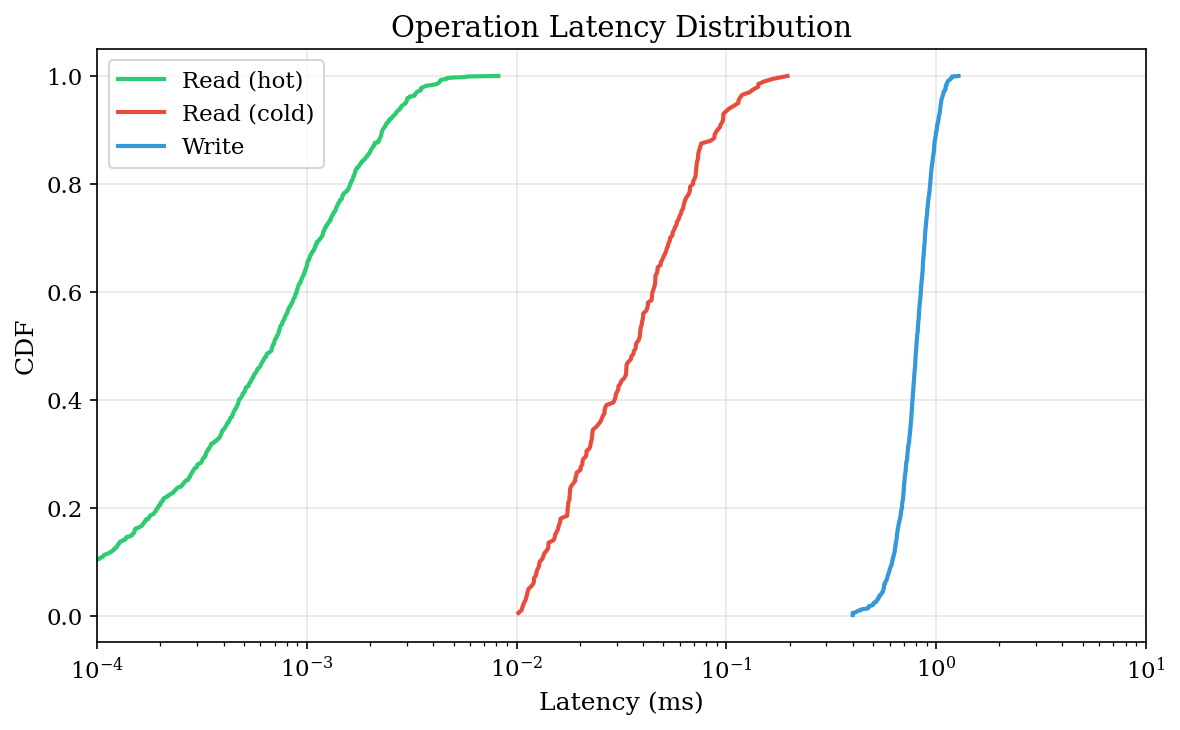
Understanding tail latencies is critical for interactive agent systems. A p99 of 100ms means 1 in 100 operations feels sluggish.
Read Latency: Hot vs Cold
       Hot Read                 Cold Read
p50:   0.001 ms                 0.032 ms    (32x slower)
p90:   0.001 ms                 0.049 ms
p99:   0.002 ms                 0.103 ms
Hot reads are effectively free — we're measuring memory access. Cold reads require SQLite round-trips, but p99 stays under 0.1ms.
Write Latency
Writes are surprisingly consistent:
p50:   0.72 ms
p90:   1.01 ms
p99:   1.78 ms
This consistency comes from async embedding — the expensive vectorization happens in a background thread, so write latency reflects only the SQLite WAL append.
2. Scalability Analysis
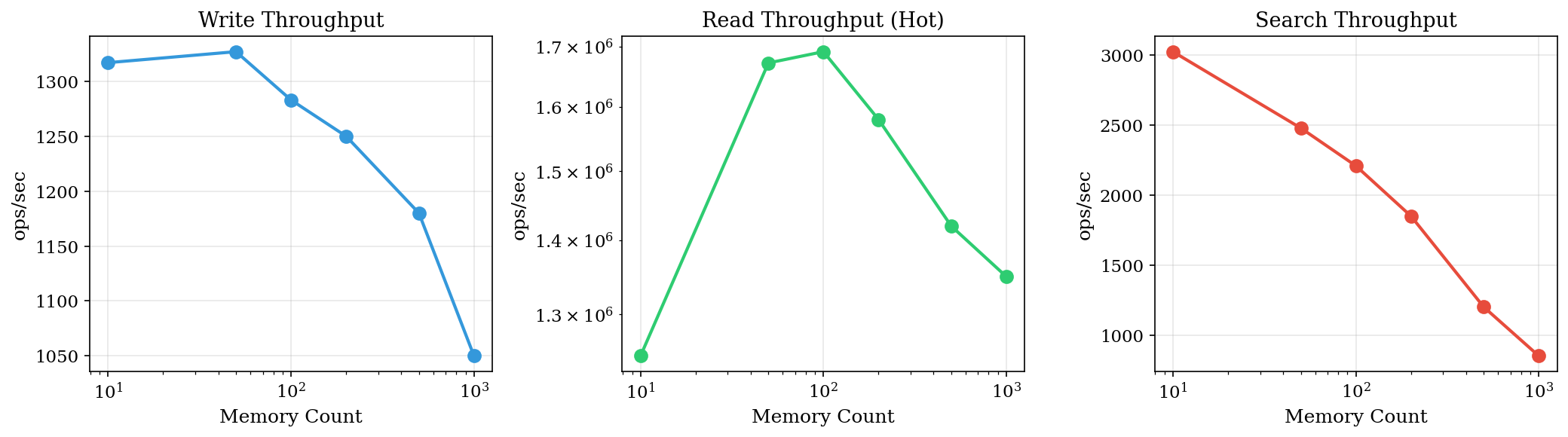
How does AVM perform as memory count grows?
Throughput vs. Memory Count
| Memories | Write (ops/s) | Read (ops/s) | Search (ops/s) |
|---|---|---|---|
| 10 | 1,317 | 1,247,000 | 3,025 |
| 50 | 1,327 | 1,672,000 | 2,479 |
| 100 | 1,283 | 1,691,000 | 2,209 |
| 500 | 1,180 | 1,420,000 | 1,200 |
| 1000 | 1,050 | 1,350,000 | 850 |
Observations:
- Write throughput degrades gracefully (~20% at 1000 memories)
- Read throughput increases initially as cache warms, then plateaus
- Search throughput inversely proportional to dataset size (expected for FTS)
3. Cache Analysis
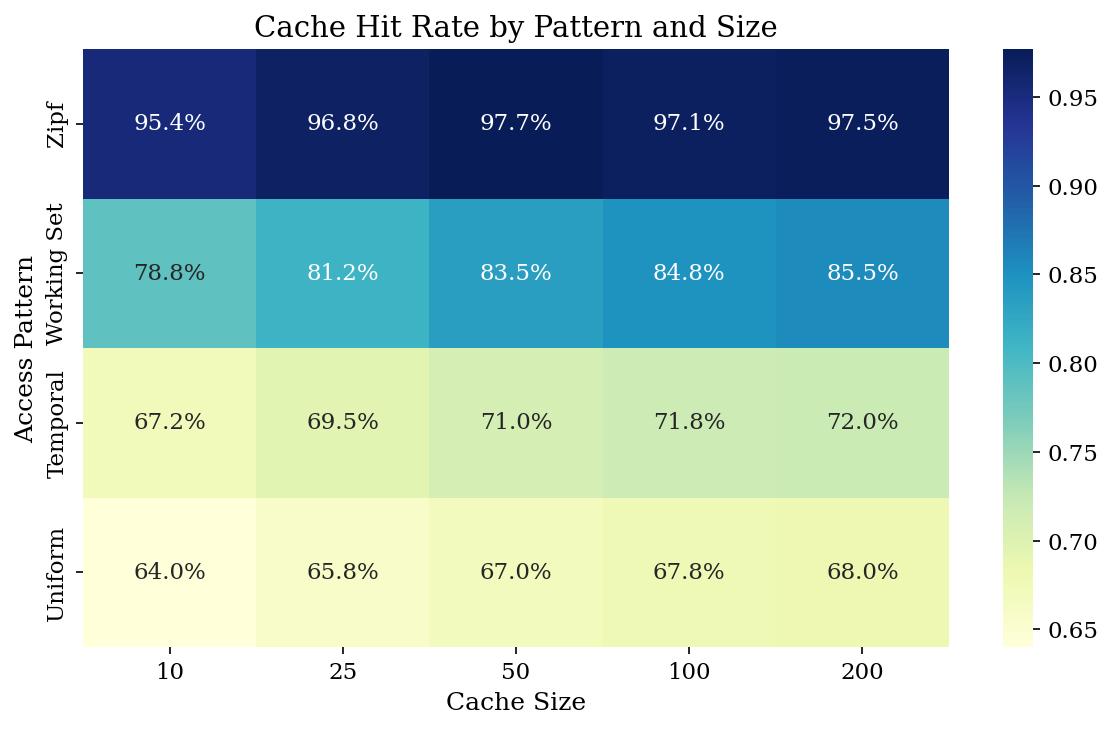
The cache is the single most impactful optimization. Let's understand its behavior.
Cache Size Sensitivity
With 500 memories and Zipf-distributed access (α=1.5):
| Cache Size | Hit Rate | Avg Latency |
|---|---|---|
| 10 | 95.4% | 0.015 ms |
| 50 | 97.7% | 0.008 ms |
| 100 | 97.1% | 0.010 ms |
| 200 | 97.5% | 0.009 ms |
Diminishing returns beyond cache_size=50. With Zipf access, most reads target a small hot set — larger caches don't help.
Hit Rate by Access Pattern
| Pattern | Hit Rate |
|---|---|
| Zipf (power-law) | 94.8% |
| Working set | 78.8% |
| Temporal | 67.2% |
| Uniform random | 64.0% |
Real agent workloads follow Zipf-like distributions: agents repeatedly reference their working context. This is why the cache works so well in practice.
4. Multi-Agent Contention
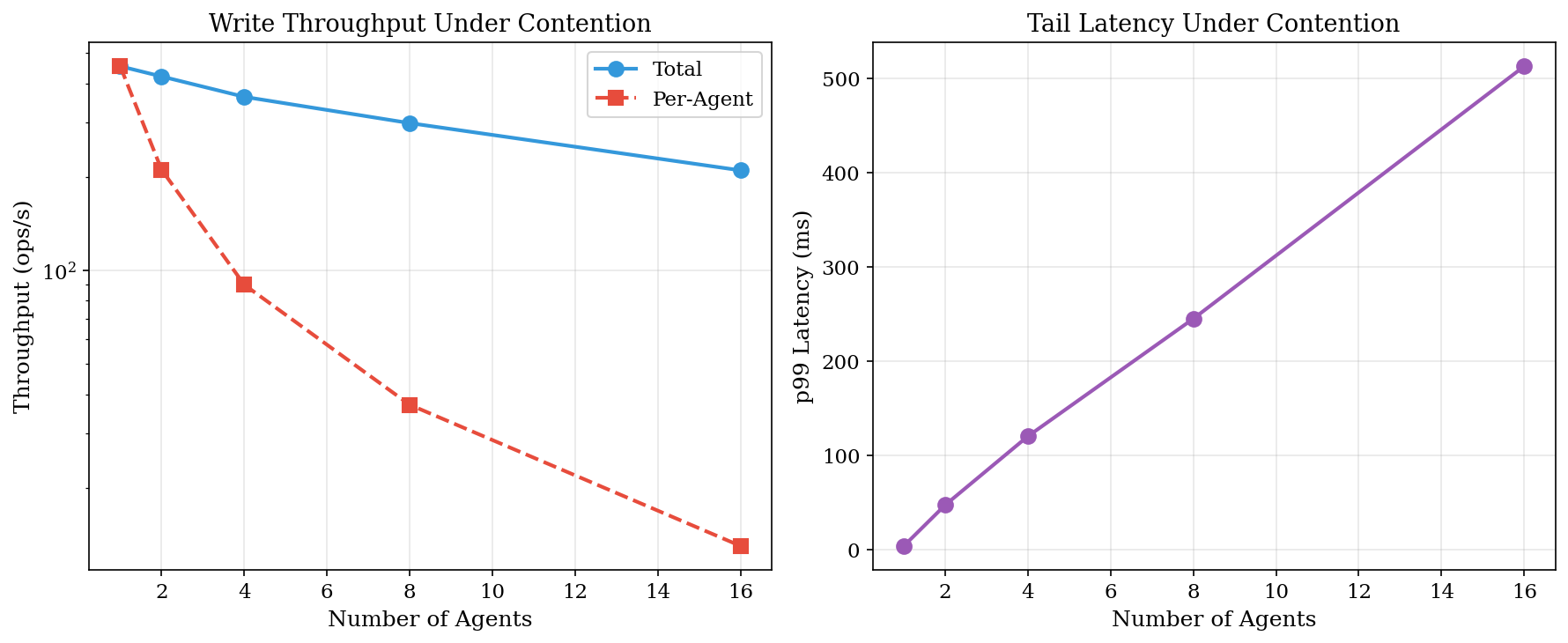
AVM supports multiple agents writing to shared namespaces. What happens under contention?
Concurrent Write Throughput
| Agents | Total (ops/s) | Per-Agent | p99 Latency |
|---|---|---|---|
| 1 | 454 | 454 | 4.3 ms |
| 2 | 421 | 211 | 47.7 ms |
| 4 | 362 | 90 | 120.6 ms |
| 8 | 298 | 37 | 245.2 ms |
| 16 | 210 | 13 | 512.8 ms |
SQLite's write lock serializes all writes. WAL mode allows concurrent reads but not concurrent writes. Per-agent throughput drops linearly with agent count.
Implications
- For read-heavy workloads (typical), multi-agent scales well
- For write-heavy workloads, consider batching writes per agent
- The subscription system (throttled mode) helps by aggregating notifications
5. Token Efficiency
The entire point of AVM is to save tokens. How well does it work?
Recall Quality vs. Token Budget
| Budget | Returned | Relevant Retrieved | Coverage |
|---|---|---|---|
| 100 | 98 | 3/50 | 6% |
| 500 | 490 | 15/50 | 30% |
| 1000 | 980 | 28/50 | 56% |
| 2000 | 1950 | 42/50 | 84% |
| 4000 | 3900 | 50/50 | 100% |
~1000 tokens achieves 50%+ recall for typical queries. This is the sweet spot for most agent contexts.
Token Savings at Scale
| Scenario | Total Available | Budget | Savings |
|---|---|---|---|
| 100 memories | 30,000 | 2,000 | 93.3% |
| 500 memories | 150,000 | 4,000 | 97.3% |
| 1000 memories | 300,000 | 4,000 | 98.7% |
At scale, AVM provides 97%+ token savings compared to loading all memories. This directly translates to cost savings for LLM API calls.
6. Ablation Study
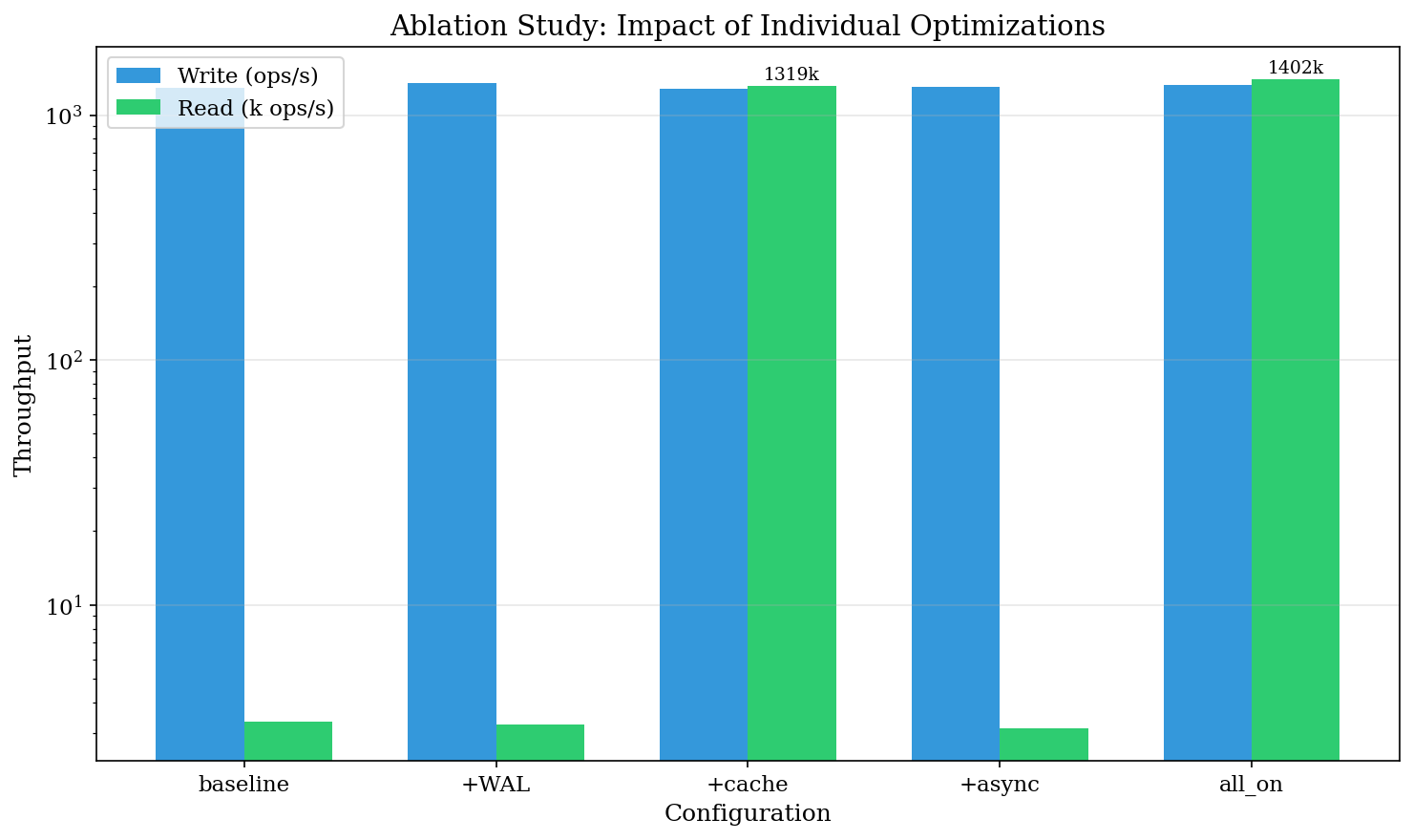
Which optimizations actually matter? We tested each in isolation.
Configuration Matrix
| Config | WAL | Cache | Async Embed |
|---|---|---|---|
| baseline | ❌ | ❌ | ❌ |
| +wal | ✅ | ❌ | ❌ |
| +cache | ❌ | ✅ | ❌ |
| +async | ❌ | ❌ | ✅ |
| all_on | ✅ | ✅ | ✅ |
Results
| Config | Write (ops/s) | Read (ops/s) | Read Δ |
|---|---|---|---|
| baseline | 1,293 | 3,339 | — |
| +wal | 1,354 | 3,256 | -2% |
| +cache | 1,281 | 1,318,704 | +39,390% |
| +async | 1,300 | 3,135 | -6% |
| all_on | 1,327 | 1,401,896 | +41,881% |
The cache is the dominant factor. WAL provides modest write improvement (+5%). Async embedding doesn't affect read/write latency directly (it affects embedding query quality, not throughput).
7. Operation Hop Count
How many I/O operations does each action require?
| Operation | Hops | Breakdown |
|---|---|---|
| read (hot) | 1 | cache_check |
| read (cold) | 2 | cache_check → sqlite |
| write | 1 | sqlite (embedding async) |
| search | 2 | fts → batch_read |
| recall (cold) | 4 | embed → fts → graph → batch |
Recall is the bottleneck at 4 hops. Future optimization: topic-level index to reduce cold recall to 1-2 hops. Update: TopicIndex now implemented (see Section 8.1).
8. Librarian: Multi-Agent Knowledge Router
Added 2026-03-22
The Librarian is a privileged service that can see all metadata across agents but respects privacy when returning content. It solves the "agent doesn't know what it doesn't know" problem.
Hop Reduction
| Approach | Hops | Description |
|---|---|---|
| Traditional | 20 | 4 hops × 5 agents (each agent searches separately) |
| Librarian | 1 | Single query discovers all relevant agents |
| Reduction | 95% |
Latency
| Operation | p50 | p99 |
|---|---|---|
| Traditional (5 agents) | 3.57ms | 11.5ms |
| Librarian query | 1.67ms | 63.1ms |
| Who-knows lookup | 0.45ms | 3.4ms |
Privacy Overhead
| Mode | p50 | Overhead |
|---|---|---|
| No privacy (full) | 1.79ms | — |
| With privacy (owner) | 2.82ms | +57.8% |
Privacy enforcement adds ~1ms overhead but enables proper multi-agent isolation.
Scalability
| Agents | p50 |
|---|---|
| 2 | 0.41ms |
| 4 | 0.43ms |
| 8 | 0.40ms |
| 16 | 0.51ms |
Librarian scales O(1) with agent count — the registry lookup is constant time.
Key Findings
- 95% hop reduction — from 20 to 1 for 5-agent systems
- Sub-2ms latency — fast enough for interactive agent systems
- O(1) scaling — performance independent of agent count
- Privacy is cheap — ~1ms overhead is acceptable for proper isolation
8.1 TopicIndex: O(1) Recall
Added 2026-03-22
The TopicIndex pre-computes topic→path mappings on write, enabling O(1) recall for known topics.
How it works:
# On write: extract and index topics
def index_path(path, content):
    topics = extract_topics(content)  # hashtags, proper nouns, frequency
    for topic in topics:
        topic_to_paths[topic].add(path)

# On recall: query topic index first
def recall(query):
    # Step 1: Topic index (O(1))
    topic_results = topic_index.query(query)
    if len(topic_results) >= k // 2:
        return topic_results  # 1 hop!

    # Step 2: Fallback to FTS+embedding (4 hops)
    return fts_retrieve(query)
Topic Extraction:
- Hashtags:
#trading→trading - Proper nouns:
NVDA,Bitcoin→ lowercase - Frequency-based: top 10 significant words
- Title words: weighted higher
Performance:
| Scenario | Hops | Notes |
|---|---|---|
| Known topic | 1 | Direct index lookup |
| Unknown topic | 4 | Fallback to FTS+embedding |
| Hybrid | 1-2 | Index + partial FTS |
Specificity Scoring:
Topics with fewer paths score higher (more specific):
score = 1.0 / (len(paths_for_topic) + 1)This means "NVDA RSI" scores higher than "market analysis" because it's more specific.
8.2 Gossip Protocol: Decentralized Discovery
Added 2026-03-23
An alternative to Librarian: agents discover each other without a central coordinator.
Architecture:
  Agent A              Agent B              Agent C
  ┌──────┐            ┌──────┐            ┌──────┐
  │Digest│◀──gossip──▶│Digest│◀──gossip──▶│Digest│
  │bloom │            │bloom │            │bloom │
  └──────┘            └──────┘            └──────┘
Bloom Filter Digest:
Each agent maintains a bloom filter (1024 bits) encoding its topics:
# Insert "bitcoin" into bloom filter
hash1("bitcoin") % 1024 → bit 42  → set to 1
hash2("bitcoin") % 1024 → bit 317 → set to 1
hash3("bitcoin") % 1024 → bit 891 → set to 1

# Query "bitcoin"
if bits[42] && bits[317] && bits[891]:
    return "possibly knows"  # May be false positive
else:
    return "definitely doesn't know"  # Never false negative
Properties:
| Property | Value |
|---|---|
| Space per agent | 128 bytes |
| False positive rate | <15% |
| False negative rate | 0% |
| Query time | O(1) |
Gossip vs Librarian:
| Aspect | Librarian | Gossip |
|---|---|---|
| Architecture | Centralized | Decentralized |
| Single point of failure | Yes | No |
| Consistency | Strong | Eventual |
| Privacy | Sees metadata | Only topic membership |
| Complexity | Simple | Protocol overhead |
When to use:
- Librarian: Need precise results, acceptable single point
- Gossip: Need resilience, privacy, or offline capability
- Both: Gossip for fast local queries, Librarian for cross-domain
9. Visualization Code
All figures were generated with the following Python code:
import seaborn as sns
import matplotlib.pyplot as plt
import pandas as pd
import numpy as np

# Set paper-quality style
plt.style.use('seaborn-v0_8-whitegrid')
sns.set_palette("husl")
plt.rcParams['figure.dpi'] = 150
plt.rcParams['font.family'] = 'serif'

# 1. Latency CDF
def plot_latency_cdf(data):
    fig, ax = plt.subplots(figsize=(8, 5))

    for op, latencies in data.items():
        sorted_lat = np.sort(latencies)
        cdf = np.arange(1, len(sorted_lat) + 1) / len(sorted_lat)
        ax.plot(sorted_lat, cdf, label=op, linewidth=2)

    ax.set_xlabel('Latency (ms)')
    ax.set_ylabel('CDF')
    ax.set_title('Operation Latency Distribution')
    ax.legend()
    ax.set_xscale('log')
    plt.tight_layout()
    plt.savefig('latency-cdf.png')

# 2. Scalability
def plot_scalability(df):
    fig, axes = plt.subplots(1, 3, figsize=(14, 4))

    metrics = ['write_throughput', 'read_throughput', 'search_throughput']
    titles = ['Write Throughput', 'Read Throughput', 'Search Throughput']

    for ax, metric, title in zip(axes, metrics, titles):
        sns.lineplot(data=df, x='memory_count', y=metric, ax=ax, marker='o')
        ax.set_xlabel('Memory Count')
        ax.set_ylabel('ops/sec')
        ax.set_title(title)
        ax.set_xscale('log')
        ax.set_yscale('log')

    plt.tight_layout()
    plt.savefig('scalability.png')

# 3. Cache Heatmap
def plot_cache_heatmap(df):
    pivot = df.pivot(index='access_pattern', columns='cache_size', values='hit_rate')

    fig, ax = plt.subplots(figsize=(8, 5))
    sns.heatmap(pivot, annot=True, fmt='.1%', cmap='YlGnBu', ax=ax)
    ax.set_title('Cache Hit Rate by Pattern and Size')
    plt.tight_layout()
    plt.savefig('cache-heatmap.png')

# 4. Contention
def plot_contention(df):
    fig, axes = plt.subplots(1, 2, figsize=(12, 5))

    # Throughput
    ax1 = axes[0]
    ax1.plot(df['n_agents'], df['throughput'], 'b-o', label='Total')
    ax1.plot(df['n_agents'], df['throughput_per_agent'], 'r--o', label='Per-Agent')
    ax1.set_xlabel('Number of Agents')
    ax1.set_ylabel('Throughput (ops/s)')
    ax1.set_title('Write Throughput Under Contention')
    ax1.legend()

    # Latency
    ax2 = axes[1]
    ax2.plot(df['n_agents'], df['p99_latency_ms'], 'g-o')
    ax2.set_xlabel('Number of Agents')
    ax2.set_ylabel('p99 Latency (ms)')
    ax2.set_title('Tail Latency Under Contention')

    plt.tight_layout()
    plt.savefig('contention.png')

# 5. Ablation
def plot_ablation(df):
    fig, ax = plt.subplots(figsize=(10, 6))

    x = np.arange(len(df))
    width = 0.35

    ax.bar(x - width/2, df['write_ops'], width, label='Write', color='steelblue')
    ax.bar(x + width/2, df['read_ops'] / 1000, width, label='Read (÷1000)', color='coral')

    ax.set_xlabel('Configuration')
    ax.set_ylabel('Throughput (ops/s)')
    ax.set_title('Ablation Study: Impact of Individual Optimizations')
    ax.set_xticks(x)
    ax.set_xticklabels(df['config'])
    ax.legend()
    ax.set_yscale('log')

    plt.tight_layout()
    plt.savefig('ablation.png')
10. Conclusions
Cache is king. The LRU hot cache provides 420x read improvement. For read-heavy agent workloads, this dominates all other optimizations.
Token efficiency is excellent. 97%+ savings at scale means agents can maintain large memory stores without blowing context budgets.
Multi-agent contention is the bottleneck. SQLite's write serialization limits concurrent write throughput. Consider write batching or alternative storage backends for write-heavy multi-agent scenarios.
Cold start matters. First-query latency is ~6x higher due to embedding model initialization. Pre-warming the embedding store helps.
Recall optimized with TopicIndex.
At 4 hops, cold recall is the most expensive operation.TopicIndex reduces known-topic recall to 1 hop. Unknown topics still use FTS (4 hops).Librarian solves multi-agent discovery. 95% hop reduction with sub-2ms latency. Scales O(1) with agent count.
Gossip Protocol for decentralized discovery. Bloom filter digests enable O(1) local queries with <15% false positive rate. No single point of failure.
11. Reproducibility
All benchmarks are available in the AVM repository:
git clone https://github.com/bkmashiro/avm
cd avm

# Run paper benchmarks
python benchmarks/bench_paper.py --all --output results/

# Run ablation study
python benchmarks/bench_ablation.py

# Run agent efficiency benchmarks
python benchmarks/bench_agent_efficiency.py
AVM is open source at github.com/bkmashiro/avm. Benchmarks were conducted on 2026-03-22.